
One operating system for the recruiting firm.
Recruit ATS, built by Dynaflow, connects the firm's records, email, LinkedIn, CVs and notes into a single operational model of the firm. Agents execute against that model. The recruiter approves every output.
How a recruiting firm uses AI
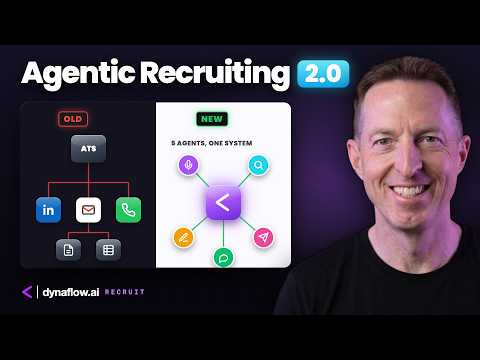
A recruiting firm's information is held in five or six systems: the ATS, LinkedIn, email, phone contacts, folders of CVs and spreadsheets. An AI tool added to one of them reads only that one. An AI operating system connects all of them, so an agent can read every client, candidate, role and conversation and the relationships between them, then do the research and the drafting. It is the system we run our own recruiting business on, built on Claude Code.
Four questions it answers.
“What do we need to do today?”
An agent reads the candidate records, email, LinkedIn messages and notes and returns a priority list: candidates waiting on client feedback, interviews not yet confirmed, offers about to expire. It drafts the follow-up to each hiring manager.
Watch the demo · 10 min“Who do we already know?”
For a new search, the agent queries the firm's own network before any outside source: call notes, the database, CVs and message threads. It returns a shortlist, each person rated A, B or C with the evidence, and a first message drafted for each.
Watch the demo · 12 min“What do we know about this candidate?”
One click reads every note, CV and message on a person record and writes one profile: a rating with its evidence, compensation with its year, results by year, timing and concerns. Where the file is silent it says "not on file".
Watch the demo · 9 min“Who is hiring that we have not called?”
A lead agent reads call notes every hour and creates the lead with its source. A research agent finds the open roles, the headcount and the hiring manager. A content agent drafts the first message in the recruiter's voice.
Watch the demo · 20 minEvery demo runs on fictional names, companies and numbers.
The recruiter decides.
- Approval
- The recruiter reads each draft on an approval screen and approves it. Approved drafts go to the recruiter's email, and the recruiter sends them.
- Blocked actions
- Hooks fire on every action an agent takes. An agent cannot send a message to a candidate or a client by itself.
- Permissions
- Access is designed around roles. A recruiter sees their own candidates and the owner sees everything.
Architecture
Six layers.
Identity, memory, connections, hooks, skills and agents. A process runs by hand as a skill until its output is reliable. Then it runs on a schedule as an agent. Firms that start with an agent and skip the first five layers get poor output.
The six layers, definedOwnership
The firm owns it.
The hosting, the dashboard, the voice and the choice of model belong to the firm. The system works with leading AI models and is not tied to one.
The series
Questions and answers
How should a recruiting firm use AI?
Bring the firm's information (candidate and client records, email, LinkedIn messages, CVs and notes) into one operating system, then have agents do the research and the drafting across all of them while the recruiter makes the decisions. Adding a separate AI tool to each piece of software leaves each tool working from a fraction of the firm's information.
Does AI replace recruiters?
No. In this system the agent reads, researches and drafts, and the recruiter decides who to call, what to say and what to send. Nothing reaches a candidate or a client without the recruiter approving it.
Do we have to replace our ATS?
No. Recruit ATS runs as a standalone ATS, and for firms that keep their ATS we can build components into your existing systems.
Where should a recruiting firm start with AI?
Start with the two questions a recruiter asks every day: what needs my attention today, and who do we already know for this search. Write each one as a skill, run it by hand until the output is reliable, and only then put it on a schedule as an agent.
Who owns the system and the data?
The firm does. It owns where the system is hosted, the dashboard, the voice the messages are written in and the choice of AI model. The firm's records stay in the firm's own system.
Scope it for your firm.
We go through your workflows and your software, and tell you where to start.
Apply15 minutes · no pitch