AI Recruiting Agents: Three Agents Running on a Real Firm
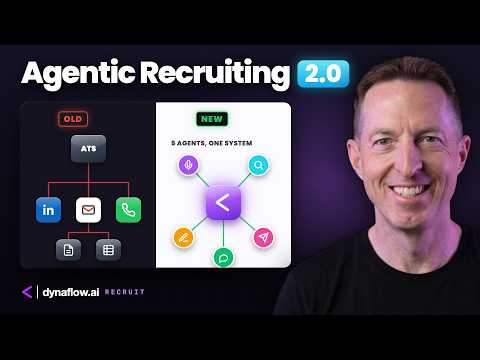
Most firms buy a sourcing tool here, a chatbot there - each sees a sliver, none sees the whole. The alternative is one agentic layer over the ATS you already run. Three agents on it, live for a US client: job admin cut from 20 minutes to 2, 47 overnight applicants screened by morning, dormant candidates mined for open roles.
Key takeaways
- Job creation: a recruiter's one-line brief becomes a full spec pulled from ATS records - 20 minutes of admin down to 2.
- Screening: 47 applicants contacted overnight and 31 screened at a 4-minute average response, surfacing 9 strong fits ranked by morning - top match 94%.
- Reactivation: silver medalists already in your database - one scoring 92%, a final-two candidate from 14 months ago. Revenue you already paid for.
Full transcript2,920 words
Recruitment is changing fast. Not because of another job board and not because of another sourcing tool. AI agents. We help recruiting companies build an agentic layer above the systems they already run.
That layer makes recruiters ultra efficient. It saves time, it saves money, and it even can help you make money. And at the end of the day, that's what we're all about. Right now, we're building one of these layers for a customer in the US.
The foundation is three agents. And in this video, I'm going to show you three things. One, a job creation agent. 20 minutes of admin down to two.
Two, a screening agent. Every applicant answered in minutes, not days. And three, a reactivation agent. This one is really cool.
It literally finds money sitting in your database. It's literally a gold mine. So, I'm going to show you some real demos today on screen and working. So, if you're a recruiter, a manager, or a business owner, this is your road map.
First, who am I and why should you listen to me? For those of you who don't know me, my name is Mike. For 20 years, I was one of the top technology recruiters in Asia. I've recruited for the biggest software companies in the world.
Service Now, Data Dog, Zendesk. m. formatting. I've definitely been there.
Today, we run Dynaflow. We install AI operating systems for enterprise AI agents, automations, and a unified knowledge base built on top of the systems a company already uses. And right now, we're building an agentic layer for a company in the US. It creates jobs, screens applicants, and finds candidates.
We know recruitment and we are building recruitment for the 21st century using AI, and I'm going to show that to you today. So, before we get into it quickly, if you run a growing business and you'd like AI inside your business, there's a link below. Click the link, book a meeting with me. 15 minutes, we'll get connected.
I'll quickly understand where your bottlenecks are and where you can benefit from AI. So before the agents, you need the ideas underneath. This is where most people get it wrong. Your firm already owns its most valuable asset, the data.
All the candidates, clients, placements, interviews, notes sitting in your ATS. And the problem is almost no one in your company or you can't use it because no one's really honestly clicking, searching, retyping. It's just kind of a hassle and they're rebuilding context every single time. So firms go and buy AI tools, a sourcing tool here, a chatbot there, and every tool sees a small part, but no tool sees the entire business.
So this is kind of where the problem is. So your team is using and you're paying for claude or ChatGPT but you and your team are only using a fraction of its potential. So the solution is an agentic layer that sits on top of your ATS and on top of your IT system. It reads, it writes back, it understands, you can have a conversation with it and it's all managed and stored on a single knowledge base.
This is a gentic AI within recruiting. So the three agents that you're about to see today are not three different products. There are three jobs running on a single unified layer. One layer to rule them all to steal a line from token.
And as far as security goes, nothing touches your actual data or gets outputed until you or someone on your team approves it. It's AIG guided recruiting, but at the end of the day, you have the final word. So you and your team make the decisions. Okay.
So we are in the job creation agent section. Now this is actually a slide presentation. So the situation is we have a client in the US. They have a team and they want an agent uh layer sitting above their system that helps create job descriptions.
Typically good recruiters don't even make job descriptions because they're so busy they can't be bothered. So we're helping this company make it really easy for them and their recruiters. consultant describes the role and then the agent finds the client and hiring contact in your database. It fills in the fields and the responsibilities and the musthaves and then a human will review and check everything in the end.
So this is the first part of the agentic layer. Here we are in the actual agent itself. So I'm going to click begin. I'd like to create a job for Apple and you can see the captured variables on the left here.
Agent comes back. Okay, great. Client corporation lookup. So this is a get request name Apple.
Three matches, Apple, Inc. Corp, and US. So the recruiter selects well actually the agent comes back and says, I found three existing client records that could be a match. Which is the role for one, two, or three?
And also, what's the title? So really the recruiter's just done one line and the agents doing the heavy lifting as you can see here. So I select just the number one and say this is a marketing director role and then the agent comes back fetching corporate excuse me fetching corporation record. This is another get request.
So it's getting the information from the ATS. It's also grabbing an ID. This is the record ID. Comes back with the full record.
Apple Inc. is an existing client. Here are the contacts on file. Who is the hiring manager?
So it's got the record. It's got the company. Now it's asking me who the hiring manager is. I select one Dave Smith.
Move this over here. And then it says fetching contact record, which is another get request into the ATS. That's Dave Smith. Got it.
Hiring manager Dave Smith. Where is the job based and what's the salary? So this job is going to be in New York and the salary is going to be 150,000. Capture New York.
New York 150,000. Now there's some also also some defaults applied on site full-time. That's pretty standard for executive search. So save some recruiter some time there.
Tell me about the mission and the responsibilities of the role. All right. Quickly overall marketing includes field digital content, PR and events. Boom.
So now the AI takes all of that information including responsibilities, musthaves, nice to haves, benefits, language. Are we good to go? Yes. And then voila, the agent outputs.
This is JSON data. This is AI data. This is the data that's going to sit above the agentic layer. And now we can do a lot of things with this data.
We can send this back into the ATS or we can create a job description for it. And you can see all the captured variable, excuse me, all the captured variables on the left hand side that we needed to do this stuff for the JD and beyond captured on the left. Let's move on to the next agent. Next is the screening agent.
This is number two. Obviously, the benefit of all of these agents and putting an agentic layer above your IT system or your ATS is to help you save time like the JD generator that we showed you. You have a quick chat with the agent and then it generates data which you can use to create a JD. This is the screening agent and the problem is the recruiter has a lot of applications coming in nightly and doesn't really have a lot of time.
So, we've created an agent that will actually go out and screen candidates. They'll have a the agent will have a conversation with the candidate via text or maybe even email, however you want to set it up. And then the recruiter wakes up in the morning and has essentially a short list of candidates ready to go based on the screening. So I'm going to show you that today.
So the input is every application that hits your job boards and your inbox. Recruiters get inundated with applications, right? That's the problem. The agent contacts every applicant within minutes, asks the asks questions and then scores the candidate for you the recruiter and then you the recruiter will make the decision.
So this is the second part of the agentic layer. Let's jump into the demo. This is the actual agent. On the upper left here we have client which is Apple uh and the role is sales executive and the location is San Francisco.
So we're doing a search as a recruiter for these parameters. Recruiter wakes up. Good morning. What came in overnight for for the Apple sales executive role.
Agent comes back pulling overnight applications. This is a get request into your ATS job sales executive which is up here. m. when the recruiter left the office.
We have seven 47 new applications. Every applicant contacted within minutes. So again, this is all automated. And then the agent comes back 47 applicants overnight.
Agent says, "I contacted everyone within minutes and asked the five questions that you wanted me to ask. " The agent comes back scoring against the role criteria ranked 31 completed screens top three below. And also on the left here you can see we have a dashboard 47 applicants 30 uh 31 screens 4 minutes average response time and nine strong fits. So again this is all designed to save you and your team time and make money scoring against the criteria.
Number one, Maria 94%. Number two Kevin 90%. Number three, Alicia, 87%. And we can see the reasons why.
Maria has 7 years of direct sales enterprise and lives in San Francisco. 4 weeks notice. She looks really good. As a recruiter, I want the agent to show me this conversation that the agent had with the with the applicant.
And then here we go. Here is the screen verbatim. So, here is the actual conversation that my agent had with the applicant. Hey Maria, thanks for applying to the SE role.
Five quick questions. How many years of experience do you have? Maria comes back seven years. So this would be maybe through a web chat or through SMS.
I mean really up to you how you want to interface this. Great. The role is in San Fran. Yes, that works.
What are your company expect? Excuse me. What are your comp expectations? 150K.
Honestly, probably wouldn't ask this question in the US, but some places we could ask it and maybe you would. I mean, it really depends on what you want to do. And if you're a busy recruiter and you want to save time, you could reframe this by saying, "Hey, the the the max budget for this is this amount. " This kind of thing.
Okay, Maria, looks good. What's What do we write here? So, four weeks timing. That's good.
And then advance all three. So, as a recruiter, I want the agent to put forward all three of these applicants. Done. Eight declines are drafted in the email.
So, I have eight drafts ready to go. I can just click send on those and that's it. So, what's happened here is overnight the agent has screened 47 candidates and come back with three really good ones. We could even take this to the next level and do a scheduling agent which I might do in the next video.
But the the benefit here is that you've got three shortlisted candidates, recruiters making money in her sleep. This is the third and final agent. Honestly, this is the money agent and the one I'm most excited about. It's the reactivation agent.
So, you have a gold mine in your ATS, but you're busy as a recruiter. You if you own a recruiting company or you're managing a team or you are a recruiter and you're very busy, there's so many candidates in your database that are not being contacted for potential jobs. We call this the candidate graveyard. And we should try and transform this graveyard into a gold mine.
So, candidate graveyard to candidate gold mine. We call it the reactivation agent. Input is a new role opens up at your firm. Again, the company is going to be Apple in this example.
And then agent searches your ATS for silver medalists and dormant ma matches. Checks the history and actually drafts an email outreach for for to be sent to the candidate. And then the recruiter, you approve the message and make sure that everything is good uh before the AI actually takes action. This is revenue that you already paid for.
So this is actually part of the agentic layer above your system that can generate revenue for you and your company. This is the third part. Let's jump into the actual agent. This is the reactivation agent.
Again, the company is Apple. The job that we are searching for is SE sales executive and the location is San Francisco. Okay. A new role just opened up with Apple sales executive direct sales based in San Francisco.
Who do we already know? This is me writing this. Boom. agent searching your candidate database.
This is a get request going into the ATS role sales executive function direct sales. These all need to be variables and fields. So it's structured data and location San Francisco. Three matches found in past pipelines.
A pipeline is the thing that you like a short list or a long list of candidates. And then what do I say here? Okay, you are so the agent has come back. You already know three strong candidates for this role.
Nobody needs to be sourced from scratch. And then we can see the candidates on the left here. One, Paul. Paul Wilson, 92%, two, Nenah, 81%.
Three, Ben, 74%. Who should I look at first? Let's look at Paul, silver medalist, final round at Apple 2024. Show me Paul Wilson is what I'm saying.
And then the agent comes back. Paul Wilson, here is what we already know. 2024 final round at Apple came second. Interview feedback strong closer higher again.
I mean that's that's a strong higher sign. Comp expectations 140K last contact 14 months ago. He was one decision away from the exact client. Want me to draft the reach out email?
Uh so this is the agent talking to me, the recruiter advising me. Yes. So then the agent writes an email for me to approve and send. And the email says when hey Paul when we worked together on the Apple process last year you made it to final two like you were number two and the feedback was outstanding.
An SC role on the direct sales has just opened on the direct sales team has just opened based in San Francisco and you were the first person we thought of. Um I might not say you came in a second. I might say something like uh well they decided to hire internally or something like this which I think was actually true from what I remember. So, this looks good and I'm just going to click approve and send and that's good to go.
So, what's happened here is we got a search and then we had a discussion with the AI. The AI came back with three candidates, Paul, Nia, Ben. Honestly, they all look good and the AI matched and drafted an email to be sent to Paul. And so, again, the benefit of all of this is that you save time.
The foundation is you and your recruiting business and the layer above that is AI. So we have looked at three things today. How to use AI on your current system. We build agentic AI above your system.
They're not tools. There are three jobs and one single agentic layer. So it was the job creation agent, the screening agent, and the reactive agent. And it's an agentic layer above your system as one unified knowledge base.
The early firms that get this are going to be the ones that can start compounding early. The late movers will not essentially every job you create, every screen, every reactivation, the earlier you do this, the better. So if you want this inside of your business, if this seems interesting to you, even remotely interesting, just click the link below, book a meeting with me. Let's get connected and we will help you first of all show you where the bottlenecks are, maybe show you where the problems are in your business.
And then second, we can show you potential solutions. And then third, we can show you a road map of how we can work together so you can take your business to the next level.
Auto-generated from the video's captions and lightly edited for readability. Commercial terms are covered on a call, not here.