Don't Automate Your Whole Business - Automate the Bottlenecks
Automating an entire business is a fast way to quit - ask Tesla about the 2018 Gigafactory. Automate three or four bottlenecks instead. This is the system running on Dynaflow today: an agentic layer over existing tools, organized like a company, with one-job agents only in the departments that actually hurt.
Key takeaways
- Map fifty workflows and you'll quit before any of them pay off - fix the three or four bottlenecks that actually cost you.
- Every agent does exactly one thing. That single constraint is what stops the system turning into chaos.
- Start today: write your top three bottlenecks, circle the one costing the most in hours, money, or sanity, and decide what an agent may do without asking.
Full transcript840 words
Everyone's selling you AI right now shows you a demo. Hey, I'm guilty of this, too. Today, I'm going to show you real AI and real automation running on my business today. One thing to note, I did not automate my entire business.
That's a fool's game. Just ask Elon Musk when he tried to automate the entire Gigafactory in 2018. It was a disaster. What I did instead was automate three or four bottlenecks.
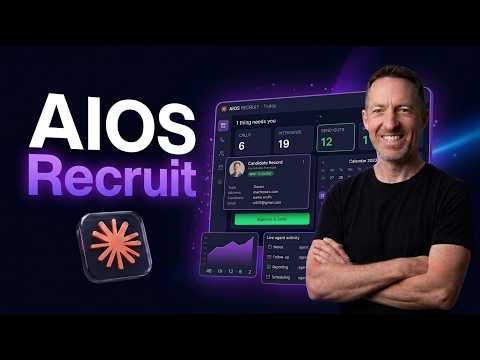
I'm Mike. We install AIOS to growing companies. And the AIOS I'm going to show you today is not theory. It's real and it's running on my business.
Trying to automate your whole business is a fast way to quit. You map 50 workflows, wire up 100 steps, and 6 weeks later, your Gigafactory 2018. The better way is to find things slowing you down that you think can be solved using AI. This is the operating system we built into Dynaflow.
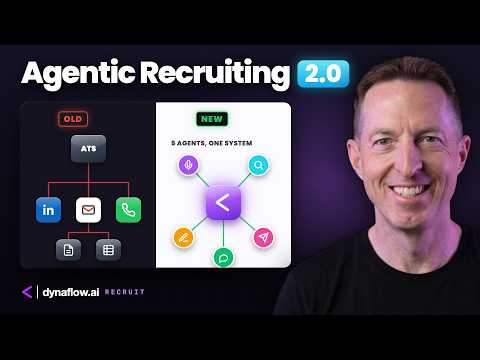
It's an agentic layer sitting over tools with a relational knowledge graph connected for context. I organized it like a company, marketing, sales, admin, engineering. And inside the departments that have bottlenecks, such as sales and admin, I put agents. Every agent has exactly one job, a prospect researcher, a follow-up manager, an assistant that runs my inbox, a librarian that keeps the knowledge base clean.
If I need something new, I add an agent. Tools. Each agent is connected to the tools I already use, Google, calendar, Drive, Slack, GitHub. Real accounts and tools running on automations and a schedule.
Skills. Think of a skill as the kung fu Morpheus gave to Neo in the Matrix. Instead of kung fu, it's cold email, competitor research, content strategy, and pipeline strategy. Assign skills to agents, and now your agents have superpowers, just like Neo.
The bottleneck. Now, here's the part that keeps from turning this into chaos. Every piece does one thing and only one thing. Personally, my bottlenecks were in sales.
Researching new prospects took forever. Follow-ups slipped through the cracks. My inbox was way too much repetitive typing. My pipeline was a mess.
So, I added one small piece for each problem. Agents. One, research agent reads the new prospect, finds the angle, and writes me a first touch draft. Two, deal agent.
Every morning, follow-up agent scans my live deals and finds what needs action. Three, email agent reads my emails, tells me what needs a reply, and writes suggestions. The mobile interface. I run this whole thing from Slack on my phone when I'm out of the office.
I can be anywhere, in a restaurant, customer meeting, a hotel, airport lounge, wherever. If you've got Slack, you have access to AI OS. The pipeline brief, the follow-up drafts, the inbox summary, they all show up in one read a suggestion and either agree with the suggestion or write back to the agent with a new suggestion. Draft a proposal for follow-ups.
Give me top three prospects for this week. Research new client contact. These are all commands I can give my agent in Slack while I'm on the road. Arthur C.
" Honestly, when this stuff starts working and compounding, it actually seems like magic. But in fact, it's AI and automation working together. Zoom out. So, let's step back and look at what this actually is.
It's one operating system running on the same approvals. This is not theory. This is not a demo that I built for the video. This is actually running in my business today.
So, what can you do to move forward on this today? Here's four simple suggestions to get you started on AI and automation. One, write your top three bottlenecks, the repeating manual stuff that is holding you back. Two, circle the one that costs you the most, hours, money, sanity, or all three.
Which one is costing you the most today? Three, decide what an agent can do and what needs permission. Anything that touches a customer or your money, you decide. And four, build incrementally.
Install your first layer. Turn that bottleneck into a scaling trigger and prove to yourself that it works before moving on to the next one. This is a practical way to start building out automations in your business today. However, if you're too busy for this, you're too busy running your business, but you want this in your business today, click apply in the link below.
It will take you to my Calendly. Pick a time and book a 15-minute meeting with me today. We'll get together briefly and I will do what I've been discussing today. Find the most painful bottlenecks in your business and start building automations around them.
This is AIOS, an architecture for your 21st century business. Also, if you like the content, please comment and subscribe to my channel. It really helps me make content for the next one. And speaking of which, see you in the next one.
Auto-generated from the video's captions and lightly edited for readability. Commercial terms are covered on a call, not here.